


Hey there! As a supplier of Titanium Round Rods, I often get asked about various technical aspects of these products. One question that pops up quite frequently is, "What is the Young's modulus of a titanium round rod?" Well, let's dive right into it and break it down in a way that's easy to understand.
First off, let's talk a bit about what Young's modulus actually is. In simple terms, Young's modulus is a measure of the stiffness of a material. It tells us how much a material will deform under a given amount of stress. When we apply a force to a material, it will stretch or compress. The Young's modulus gives us an idea of how resistant the material is to that stretching or compressing. It's calculated as the ratio of stress (force per unit area) to strain (the relative deformation of the material).
Now, when it comes to titanium round rods, the Young's modulus can vary depending on a few factors. The type of titanium alloy used is one of the main factors. There are different grades of titanium alloys, each with its own unique properties. For example, Grade 2 titanium is a commercially pure titanium that's known for its good corrosion resistance. On the other hand, Gr5 titanium alloy, also known as Ti-6Al-4V, is a high-strength alloy that's widely used in aerospace, medical, and other high-performance applications.
The Young's modulus of commercially pure titanium (like Grade 2) is typically around 103 GPa (gigapascals). This means that for every unit of stress applied, the material will deform a certain amount based on this value. It's a relatively high value, which indicates that titanium is a fairly stiff material. This stiffness is one of the reasons why titanium is so popular in applications where strength and rigidity are important.
For Gr5 titanium alloy (Ti-6Al-4V), the Young's modulus is around 114 GPa. This is slightly higher than that of commercially pure titanium, which makes sense because the alloying elements in Gr5 (aluminum and vanadium) enhance its strength and stiffness. The higher Young's modulus of Gr5 means that it can withstand higher stresses before deforming compared to Grade 2 titanium.
So, why does the Young's modulus matter when it comes to titanium round rods? Well, if you're using a titanium round rod in a structural application, you need to know how it will behave under load. For example, if you're building an aircraft component, you want to make sure that the titanium round rod can handle the stresses and strains it will encounter during flight without deforming too much. The Young's modulus helps engineers and designers make these calculations and ensure the safety and performance of the final product.

Another important aspect is the relationship between Young's modulus and other mechanical properties of titanium round rods. For instance, the yield strength (the stress at which a material begins to deform plastically) and the ultimate tensile strength (the maximum stress a material can withstand before breaking) are also closely related to the Young's modulus. Generally, materials with higher Young's moduli tend to have higher yield and ultimate tensile strengths.
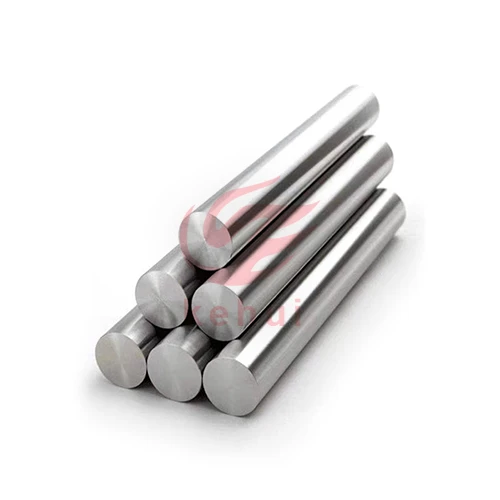
At our company, we offer a wide range of titanium round rods, including ASTMB348 GR2 Gr5 Ti Alloy Round Bar and Gr5 High Strength Titanium Alloy Bar. These products are made from high-quality titanium alloys and are carefully manufactured to meet the strictest industry standards. We also have China High Quality Titanium Alloy TI6AL4V Medical Material available for medical applications, where the unique properties of titanium, such as its biocompatibility and high strength-to-weight ratio, are highly valued.
When you're choosing a titanium round rod, it's important to consider your specific requirements. If you need a rod with high corrosion resistance and moderate strength, Grade 2 titanium might be a good choice. On the other hand, if you need a rod with high strength and stiffness for demanding applications, Gr5 titanium alloy would be more suitable.
In addition to the Young's modulus and other mechanical properties, we also pay close attention to the surface finish and dimensional accuracy of our titanium round rods. A smooth surface finish not only improves the appearance of the rod but also reduces the risk of stress concentrations and corrosion. And accurate dimensions ensure that the rod fits perfectly into your application, which is crucial for the overall performance and reliability of your product.
We understand that every customer has different needs, so we offer custom manufacturing services. Whether you need a specific diameter, length, or surface treatment for your titanium round rod, we can work with you to make it happen. Our team of experienced engineers and technicians will work closely with you to understand your requirements and provide you with the best solution.
If you're in the market for titanium round rods and have any questions about Young's modulus or other technical aspects, don't hesitate to reach out to us. We're here to help you make the right choice and ensure that you get the highest quality products for your application. Whether you're a small business or a large corporation, we can provide you with the titanium round rods you need at competitive prices.
In conclusion, the Young's modulus of a titanium round rod is an important property that affects its mechanical behavior and performance. By understanding the Young's modulus and how it varies with different titanium alloys, you can make informed decisions when choosing a titanium round rod for your application. At our company, we're committed to providing high-quality titanium round rods and excellent customer service. So, if you're interested in purchasing titanium round rods, please contact us for more information and to discuss your specific requirements.
References:
- "Titanium: A Technical Guide" by John C. Williams
- "Materials Science and Engineering: An Introduction" by William D. Callister Jr. and David G. Rethwisch