


Hey there! I'm a supplier in the titanium forging business, and today I wanna chat about how titanium forging impacts material thermal conductivity. It's a topic that's super important in our industry, and I'm stoked to share my insights with you.
First off, let's understand what titanium forging is. In simple terms, it's a manufacturing process where we shape titanium by applying compressive forces. This process can change the internal structure of titanium, and that's where things get interesting when it comes to thermal conductivity.
Thermal conductivity is all about how well a material can transfer heat. For many applications, like in aerospace and automotive industries, having the right thermal conductivity is crucial. Titanium, on its own, has a relatively low thermal conductivity compared to some other metals like copper or aluminum. But when we start forging it, things can change.

One of the main effects of titanium forging on thermal conductivity is related to the grain structure. During forging, the grains in the titanium can be refined and aligned. When the grains are smaller and more uniformly aligned, it can actually improve the thermal conductivity. Think of it like a highway for heat. If the road is well - structured and straight, heat can travel more easily. Smaller grains provide more direct paths for heat to flow through the material, reducing the resistance to heat transfer.
Another factor is the presence of defects. In an unforged titanium piece, there might be voids, cracks, or other defects. These defects act as barriers to heat flow. When we forge titanium, we can close up many of these defects. By eliminating these barriers, heat can move more freely through the material, thus increasing its thermal conductivity.
But it's not always a straightforward increase. Sometimes, forging can introduce new stresses in the material. These stresses can disrupt the normal flow of heat. If the forging process isn't carefully controlled, these stresses can cause the thermal conductivity to decrease. For example, if we apply too much force during forging, it can cause the grains to deform in an irregular way, creating a more chaotic structure that heat has a hard time navigating through.
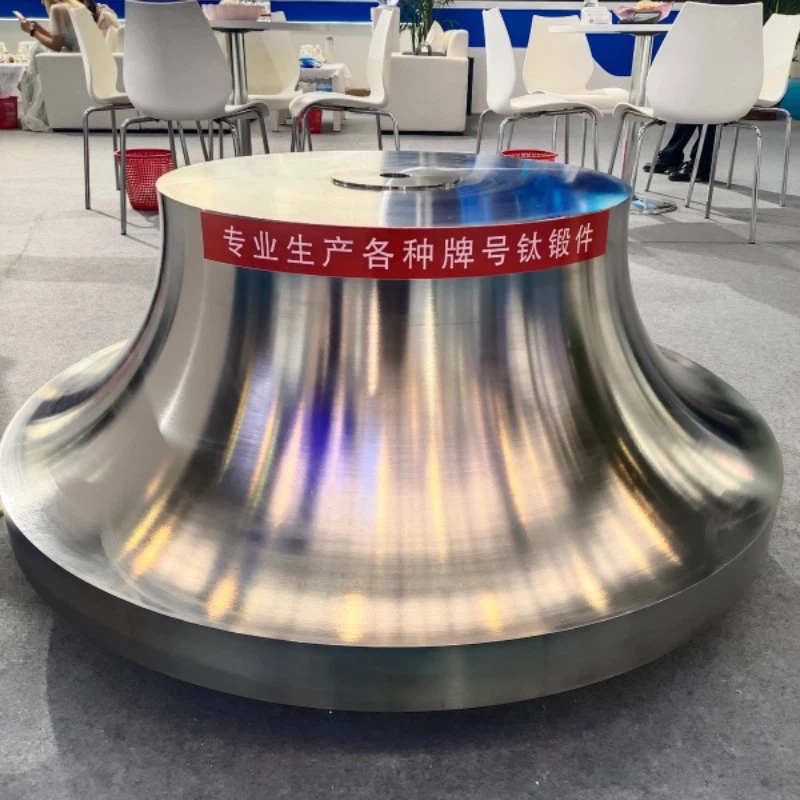
Let's talk about some real - world applications. In the aerospace industry, components made from The Largest Titanium Impeller Forging in Asia need to have specific thermal conductivity properties. The impellers are exposed to high - temperature environments, and proper heat transfer is essential for their performance. By carefully forging the titanium, we can optimize the thermal conductivity to ensure that the impellers can handle the heat without any issues.
The Ti6Al4V Titanium Forging Disk is another great example. Ti6Al4V is a popular titanium alloy, and forging it can have a significant impact on its thermal conductivity. In automotive engines, these disks are used in various parts where heat management is crucial. A well - forged Ti6Al4V disk can transfer heat more efficiently, which can lead to better engine performance and longer component life.
The Gr5 Ti6Al4V Titanium Impeller is also a key component in many industrial applications. The forging process can be tailored to achieve the desired thermal conductivity for these impellers. Whether it's in a chemical plant or a power generation facility, having an impeller with the right thermal conductivity can make a big difference in the overall efficiency of the system.
As a titanium forging supplier, I know how important it is to get the forging process right to achieve the desired thermal conductivity. We use advanced techniques and state - of - the - art equipment to ensure that every piece of forged titanium meets the highest standards. Our team of experts carefully monitors each step of the forging process, from the initial heating to the final shaping.
If you're in the market for high - quality titanium forgings with optimized thermal conductivity, I'd love to have a chat with you. Whether you're in the aerospace, automotive, or any other industry that requires precise heat transfer properties, we can work together to find the perfect solution for your needs. Reach out to me, and let's start a conversation about how our titanium forgings can benefit your projects.
References
- "Titanium: A Technical Guide" by John R. Davis
- "Forging Technology and Applications" by George E. Totten and David Scott MacKenzie
- Industry research reports on titanium forging and thermal conductivity